 Hydropower in France in 2025 – Still the indispensable backbone of the energy mix
by FPDieulois :: 2025-11-14
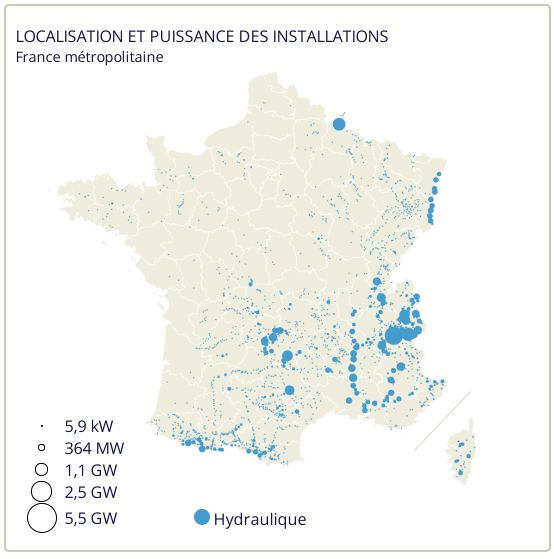
France 2025: Installed capacity: 25,700 MW (2nd largest fleet in Europe after Norway)
Average annual production: 63–68 TWh (11–12 % of French electricity consumption)
2024 (exceptionally dry year): only 53.2 TWh – the lowest figure since 1976
2025 forecast (if rainfall returns to normal): 65–68 TWh
Reservoir filling rate on 15 November 2025: 82 % (compared with 68 % a year earlier)
The three faces of French Hydropower
France combines three very different types of hydroelectric production:
High-head reservoir plants (Alps, Massif Central, Pyrenees) – 55 % of total capacity
Run-of-river plants (Rhône, Rhine, Garonne, Dordogne) – 35 %
Pumped-storage Hydropower plants (STEP/PSH) – 10 % of capacity, but decisive for grid flexibility
Special focus: Roselend – La Bâthie, the Alpine jewel
Nestled in the Beaufortain massif in Savoie, the Roselend–La Bâthie complex perfectly embodies the power and beauty of French mountain Hydropower.
Roselend dam: 150 m high, 804 million m³ reservoir, turquoise lake that has become an emblem of the French Alps
La Bâthie underground power station (6 Pelton turbines of 91 MW each)
Total installed capacity: 546 MW
Average annual production: almost 1 TWh – equivalent to the electricity consumption of the city of Lyon
Start-up time: full power in less than 3 minutes – ideal for covering the evening peak
Roselend is not only a postcard; it is a strategic asset for RTE when wind and solar drop at the same time.
Production 2020–2025: the brutal drought shock (detailed year-by-year comparison)2020 - 67.2 TWh
A “normal” year, slightly above the long-term average.2021 - 59.8 TWh (-11 %)
First signs of lower snowfall in the Alps and reduced spring melt.2022 - 48.3 TWh (-28 % compared to 2020)
Absolute historic low since 1976. Combined effect of the heat wave and the most severe hydrological drought ever recorded in France.2023 - 56.1 TWh (+16 % compared to 2022)
Slight recovery thanks to a wetter winter, but still well below average.2024 - 53.2 TWh (provisional)
Another very dry year, particularly in the Mediterranean arc and the Pyrenees.2025 - 65–68 TWh (RTE forecast if normal rainfall)
The return of Atlantic disturbances since autumn 2025 and good snowfall in the Alps make it possible to hope for a clear rebound.
Top 10 most powerful French hydroelectric plants (2025 ranking)Grand ’Maison (Isère) – 1,820 MW (pumped storage)
Montezic (Aveyron) – 1,020 MW (pumped storage)
Roselend–La Bâthie (Savoie) – 546 MW
Génissiat (Ain) – 420 MW
Tignes–Brevières (Savoie) – 400 MW
Serre-Ponçon (Hautes-Alpes) – 380 MW
Bissorte (Savoie) – 375 MW
Castillon (Alpes-de-Haute-Provence) – 340 MW
Vouglans (Jura) – 280 MW
Le Pouget (Hérault) – 270 MW

Pumped-storage plants: France’s giant batteries
The six major French STEP can:Inject 5,000 MW in less than 5 minutes (the equivalent of five nuclear reactors)
Store almost 100 GWh – nearly two days of average French consumption
In winter, when solar production is almost zero and wind is erratic, these stations are the only large-scale means of balancing the grid in real time.
Projects and outlook 2025–2035Redon (Pyrénées-Orientales): brand-new 100 MW dam – work starts in 2025
Possible extension of Grand’Maison (+200 MW) under feasibility study
Small modular plants (POM programme): 200–300 MW of new capacity planned by 2030
Selective decommissioning: around ten very small dams (<1 MW) removed each year for ecological continuity
Hydropower vs intermittent renewables: complementarity rather than competition
Unlike wind and solar, hydropower (especially reservoir and pumped-storage) is fully controllable.
It therefore remains:The fastest flexibility tool (seconds to minutes)
The most economical large-scale storage solution
The guarantor of security of supply when renewables are insufficient
Conclusion
Despite two catastrophic years in 2022 and 2024, French hydropower has lost none of its strategic importance.
With the return of rainfall forecast for 2025–2026 and the new projects in the pipeline, it is preparing to regain its historic place as
the second largest source of electricity behind nuclear power.Far from being a relic of the 20th century, hydropower
– illustrated by emblematic sites such as Roselend – remains the essential flexible partner for achieving a decarbonised mix that is both renewable and secure.
Sources: RTE – Bilan électrique 2024 and winter outlook 2025/26, EDF Hydro, IEA Hydropower Status Report 2025, French Ministry of Ecological Transition.

< B > My Personal Blog < B > List of all my Blog posts < B >
Article generated & inserted in SQL tables by AIs

FREDDY FRANCE Blog personnel
(c)FPe COPYRIGHT @FPDIEULOIS 2026