 Fried Green Tomatoes: An Ode to Equality, Solidarity, and Newman’s Soaring Score
by FPDieulois :: 2025-11-22
with help of xAI Grok
Fried Green Tomatoes (1991), directed by Jon Avnet, is a heartfelt gem in my 50 favorite films
a Southern tapestry weaving equality across gender, race, and wealth, unbreakable solidarity, and compassion for the disabled,
all lifted by Thomas Newman’s aerial, luminous music. While Ridley Scott’s visual poetry peaked in Prometheus (2012) before Alien: Covenant’s (2017) fall,
Avnet—adapting Fannie Flagg’s novel—crafts a warm, defiant celebration of human connection.
With Kathy Bates’ transformative Evelyn, Jessica Tandy’s wise Ninny, Mary Stuart Masterson’s fierce Idgie, and Mary-Louise Parker’s gentle Ruth, it’s a story of rebellion and love that transcends time.
Equality Across Gender, Race, and Wealth: Breaking Chains in Whistle Stop
Set in 1920s–30s Alabama and framed by 1980s nursing home chats, the film dismantles barriers with quiet revolution.
Idgie Threadgoode (Masterson), a tomboy defying Southern femininity, runs the Whistle Stop Café with Ruth (Parker)
a haven where Black workers like Sipsey (Cicely Tyson) and Big George (Stan Shaw) eat alongside whites, share profits, and face Klan terror together.
Wealth means nothing: poor sharecroppers and rich widows sit at the same table.
Gender roles shatter—Idgie in pants, Ruth widowed yet free—while class lines blur in acts of generosity, like feeding the homeless during the Depression.
Solidarity and the Disabled: Bonds Stronger Than Steel
The café is a fortress of loyalty: when Frank Bennett abuses Ruth, Idgie and Big George orchestrate justice—murder disguised as barbecue, a secret guarded for decades.
Solidarity extends to the marginalized: Buddy Jr., Ruth’s son, loses an arm but gains a family that never pities him.
Evelyn (Bates), stuck in a loveless marriage, finds rebirth through Ninny’s tales—her “Towanda” rage a feminist awakening.
Even the disabled elderly in the nursing home are treated with dignity, their stories the film’s lifeblood.
Thomas Newman’s Aerial Music: Wings Over Whistle Stop
Newman’s score—soaring, delicate, full of wonder—lifts every scene into the heavens.
*Piano tinkles like sunlight on rails, strings swell like summer storms, a lone whistle evokes trains carrying dreams.
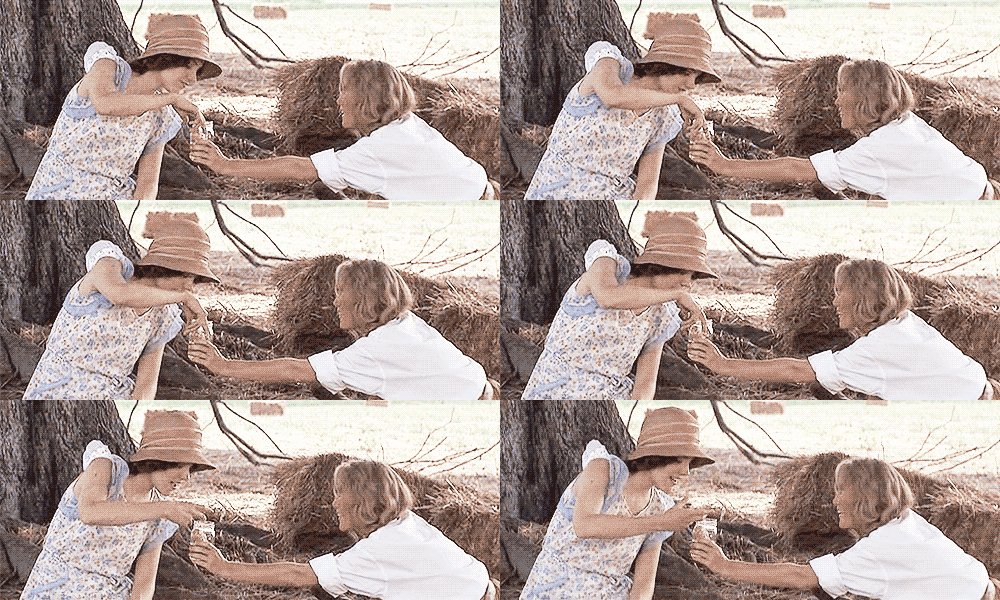
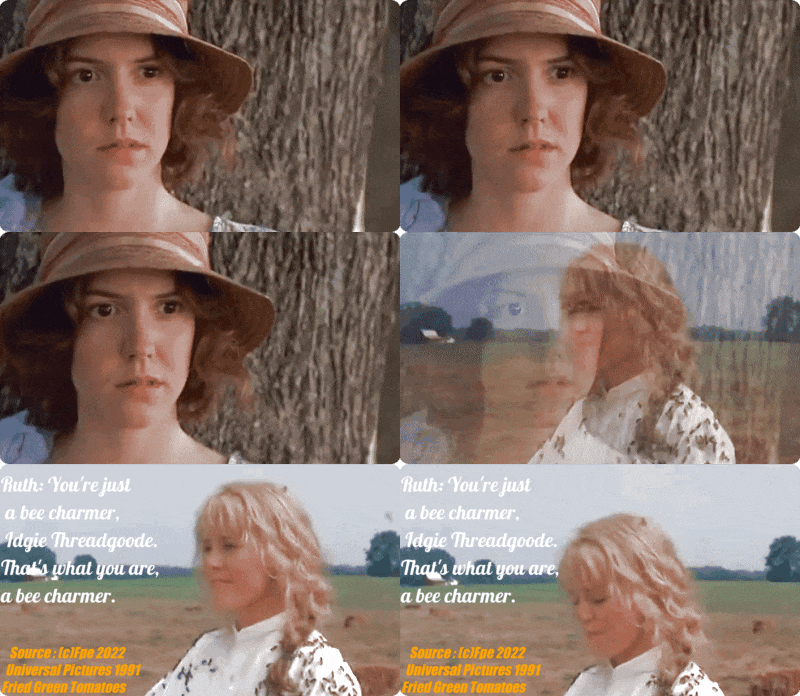
The main theme, with its gliding melody, feels airborne—freedom in sound. It underscores Idgie’s bee-charming,
Evelyn’s food-flinging epiphany, the trial’s tension, and the final revelation. Newman doesn’t tug heartstrings;
he is the wind beneath them.Avnet, with Flagg co-writing, balances humor and heartbreak: the food fight, the train death,
the murder cover-up, the lesbian subtext between Idgie and Ruth—never stated, always felt. Bates transforms from frumpy to fierce;
Tandy’s Ninny is pure light; Masterson and Parker burn with unspoken love.
Fried Green Tomatoes isn’t just a film—it’s a manifesto of inclusion, served with grits, courage, and a side of honey.
Idgie and Ruth's relationship
Fried Green Tomatoes: The Unspoken Flame of Idgie and Ruth
In Fried Green Tomatoes (1991), the relationship between Idgie Threadgoode (Mary Stuart Masterson) and Ruth Jamison (Mary-Louise Parker)
is the film’s quiet heartbeat—an unspoken love that defies 1920s Southern convention, yet radiates in every glance, gesture, and sacrifice.
While the narrative frames their bond as deep friendship, the subtext pulses with romantic intensity, making it one of cinema’s most tender, coded queer love stories.
Jon Avnet and Fannie Flagg (who wrote the source novel and co-wrote the screenplay) weave this connection with restraint and power, letting silence speak louder than declaration.
A Love Forged in Defiance and Rescue
From their first meeting—Idgie, wild and untamed, crashing Ruth’s brother Buddy’s funeral in overalls—the spark is immediate.
Ruth, soft-spoken and trapped in an abusive marriage to Frank Bennett, represents everything Idgie rebels against: conformity, fragility, fear.
Yet Idgie is drawn to her light. When Ruth sends a postcard pleading for help, Idgie storms in with Big George, liberates her from Frank’s violence, and brings her back to Whistle Stop.
This isn’t just solidarity—it’s devotion. The café they build together becomes their shared world, a sanctuary where gender roles dissolve and love, in all its forms, thrives.
Coded Intimacy: Gestures Louder Than Words
The film never says “love,” but shows it relentlessly: Idgie charming bees bare-handed to impress Ruth, her grin saying “Look what I’d do for you.”
Ruth brushing Idgie’s hair after a fight, fingers lingering, eyes soft with unspoken longing.
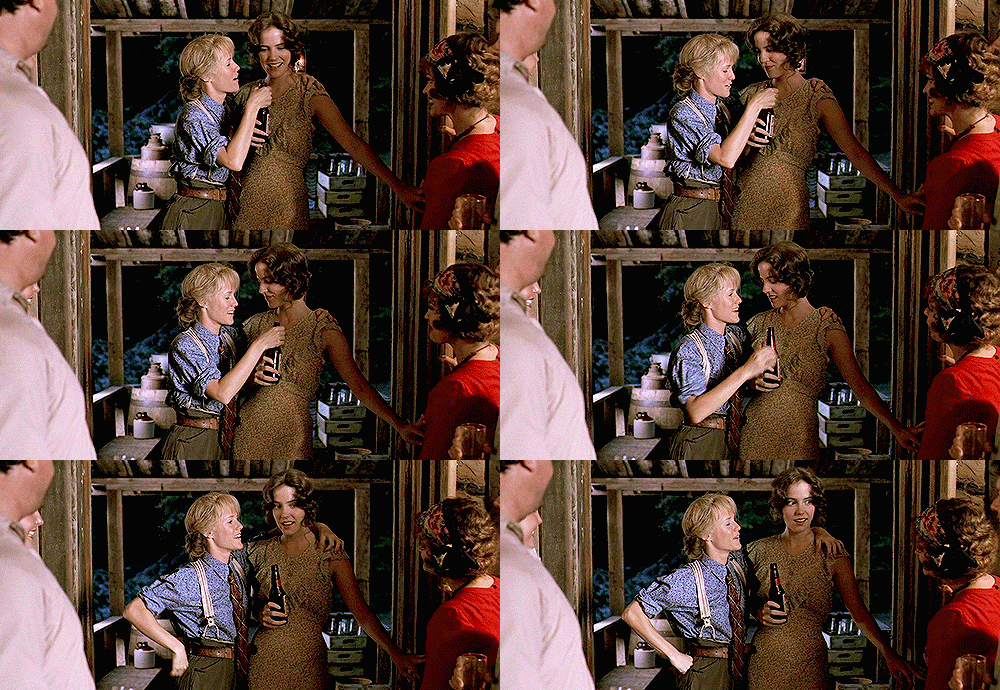
Their late-night talks on the café porch, laughter cutting through cicada song, bodies leaning closer than friends need to.
The way Ruth says “Idgie” like a prayer, and Idgie’s voice cracks only when Ruth is near.
Even the food—fried green tomatoes, honey-drizzled biscuits—becomes erotic shorthand: Idgie feeding Ruth, Ruth teaching Idgie gentleness.
It’s sensual without being overt, passionate without a kiss.
Sacrifice and Eternal Bond
When Ruth dies of cancer, Idgie’s grief is visceral—she stops speaking, haunts the café like a ghost.
The trial scene, where the town lies to protect her from murder charges, is less about justice than loyalty to their love.
And in the final reveal—Ninny placing Ruth’s jar of honey on Idgie’s grave with a bee inside—it’s clear: Ruth was Idgie’s home, her reason, her everything.
The bee, buzzing free, is their love—wild, uncontainable, eternal.
Flagg’s novel is more explicit—Idgie and Ruth live as partners—but the film, bound by 1991 Hollywood, uses subtext masterfully.
Their relationship mirrors real queer lives of the era: hidden, coded, but no less real.
Masterson plays Idgie with swagger and vulnerability; Parker gives Ruth luminous strength.
Together, they embody a love that doesn’t need labels—it simply is.
In a film about equality and solidarity, Idgie and Ruth are the purest expression: two women who choose each other, build a life, and protect it with blood, lies, and unbreakable loyalty.
Their love isn’t the loudest story in Fried Green Tomatoes—but it’s the truest.
with help of Google Gemini
< B > My Personal Blog < B > List of all my Blog posts < B >
Article generated & inserted in SQL tables by AIs

FREDDY FRANCE Blog personnel
(c)FPe COPYRIGHT @FPDIEULOIS 2026