 The Green Mile 1999 The Thin Line Between Good and Evil, God’s Messenger and His Miracles
by FPDieulois :: 2026-01-25
with help of xAI Grok
The Green Mile (1999), Frank Darabont’s profound adaptation of Stephen King’s novel, stands as a towering entry in my 50 favorite films
—a meditation on innocence, cruelty, and redemption set in the shadow of death.
While Ridley Scott’s visual poetry shone in Prometheus (2012) before Alien: Covenant’s (2017) faltering,
Darabont crafts a deeply humane epic. Tom Hanks’ compassionate Paul Edgecomb, Michael Clarke Duncan’s gentle giant John Coffey,
the razor-thin frontier between wrong and right, Coffey as a divine envoy with miraculous gifts,
and the suffocating death row ambiance create a film that breaks the heart and lifts the soul.
The Thin Line Between Wrong and Right: A Fragile Moral Frontier
The film’s core philosophy—that the boundary between good and evil is “bien mince”—permeates every frame.
Guards like Paul and Brutus (David Morse) are decent men enforcing injustice;
Percy Wetmore (Doug Hutchison) embodies petty sadism in uniform.
Wild Bill Wharton (Sam Rockwell) is pure chaos, yet even he pales against the true monsters.

Darabont shows morality as grayscale: Paul’s growing doubt, his quiet rebellion against the system,
underscores how easily right becomes wrong in the name of duty.
John Coffey as God’s Messenger: Miracles in Chains
Michael Clarke Duncan’s John Coffey—initials J.C., towering yet childlike—is the film’s Christ figure,
an innocent condemned bearing others’ pain.
His miracles are humble yet staggering: resurrecting Mr. Jingles the mouse, curing Paul’s infection with a glowing touch,
absorbing Melinda Moores’ tumor in a storm of light and insects.
“I’m tired of the pain,” he weeps, sensing the world’s evil.
Duncan’s performance—soft voice, fearful eyes, immense gentleness—makes Coffey a divine envoy trapped in human brutality, his gifts a curse in a world too dark to deserve them.
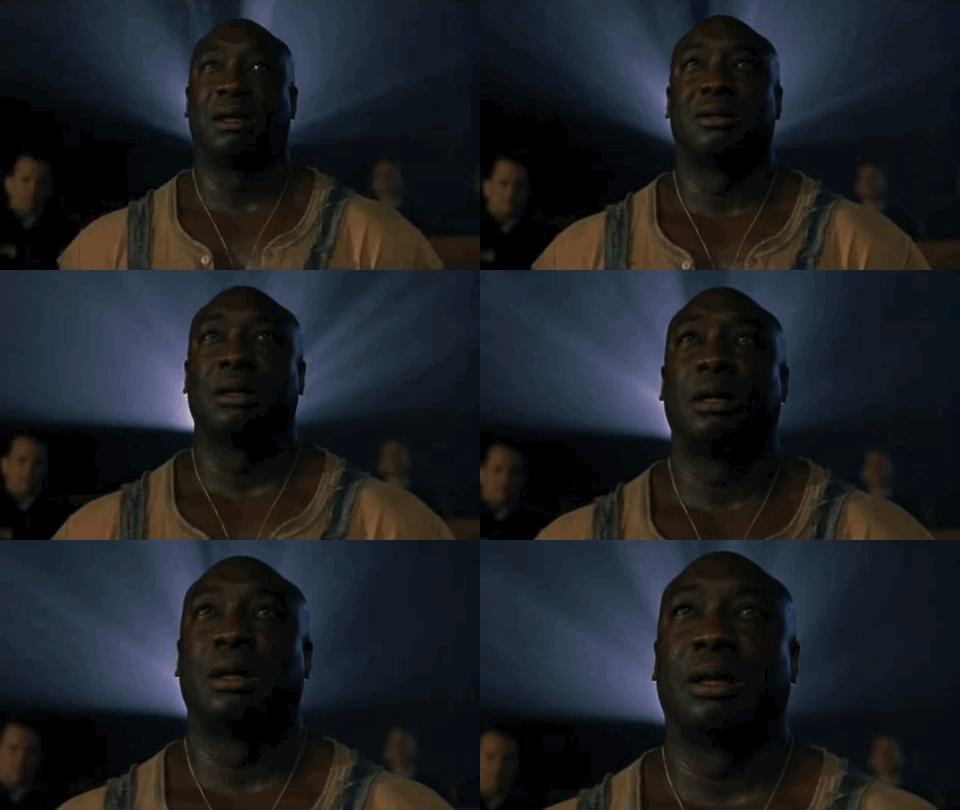
The Prison Atmosphere: The Green Mile’s Suffocating Weight
Death row’s “Green Mile”—lime-painted linoleum leading to “Old Sparky”—is a claustrophobic hell of flickering bulbs,
echoing footsteps, and humid Louisiana air.
Cinematographer David Tattersall bathes it in sickly greens and shadows: cells like tombs, the electric chair a throne of terror.
The ambiance is palpable—sweat-soaked uniforms, the hum of fans, the dread before executions. Darabont lingers on rituals:
the sponge test, the final walk, the witnesses’ hushed horror—making the prison a living entity of despair and fleeting humanity.
Darabont, faithful to King yet cinematic, balances tenderness (Mr. Jingles’ antics) with horror (Delacroix’s botched execution).
Hanks anchors with quiet authority; Duncan breaks hearts with vulnerability.
Thomas Newman’s haunting score—piano sighs, choral swells—elevates the spiritual.
The Green Mile isn’t just a prison drama—it’s a fable of light in darkness,
where miracles flicker but evil often wins.

with help of Google Gemini
< B > My Personal Blog < B > List of all my Blog posts < B >
Article generated & inserted in SQL tables by AIs

FREDDY FRANCE Blog personnel
(c)FPe COPYRIGHT @FPDIEULOIS 2026