 Tribute to Nicolas de Staël: The Tortured, Demanding Painter Who Sacrificed Everything
 by FPDieulois :: 2026-02-27
with help of xAI Grok
Nicolas de Staël (1914–1955) remains one of the most haunting figures of 20th-century painting:
a Russian exile who became French, an ascetic genius who burned with relentless intensity,
a man who demanded perfection from his art—and from himself—at any cost.
His life was marked by exile, orphanhood, war, fleeting successes, and a tragic, seemingly inevitable end.
On March 16, 1955, at the age of 41, he leapt to his death from the terrace of his eleventh-floor studio in Antibes, on the French Riviera.
The act came after a disappointing encounter with a critic, amid exhaustion, depression, insomnia, and an unrequited passion that shattered him.
Yet de Staël's story is not merely one of despair.
It is the chronicle of an artist who sacrificed family stability, romantic happiness, and personal peace on the altar of an uncompromising vision.
His thick impasto, vibrant yet tormented colors, and oscillation between abstraction and landscape captured light and matter with a feverish urgency
—as if he knew time was short.
Exile, Loss, and the Birth of an Ascetic
Born Nikolai Vladimirovich Staël von Holstein in Saint Petersburg on January 5, 1914 (December 23, 1913, old calendar), into an aristocratic military family,
de Staël's early life was defined by upheaval.
The 1917 Russian Revolution forced his family into exile: first to Poland, then Brussels.
Both parents died in 1922 when he was only eight, leaving him and his siblings to be raised by a foster family.
Orphaned and uprooted, he developed an early sense of isolation that never left him.
In Brussels, he studied art and architecture, but his true formation came in Paris after 1938.
There he met Jeannine Guillou, a painter who became his companion and muse.
They lived together intensely; she had a son from a previous relationship, and in 1942 they had a daughter, Anne.
During the Nazi occupation, life was harsh—malnutrition, fear, scarcity.
Jeannine died tragically in February 1946 from complications linked to wartime hardship and an abortion.
De Staël was devastated, left to raise Anne and her half-brother alone while pouring his grief into increasingly dense, anguished canvases.
Success arrived in the late 1940s and early 1950s. Galleries like Jeanne Bucher and exhibitions at the Salon de Mai brought critical acclaim and commercial demand.
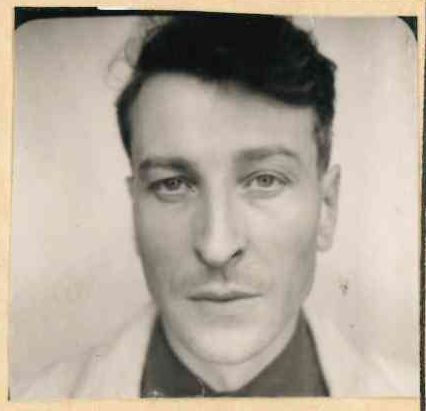
By 1953–1954, he was painting at a frantic pace—hundreds of works in a few years
—while living ascetically in his studio, despising artists who "sat back smugly" after early success.
He married again in 1954 and had a son, Gustave, but domestic life could not contain his inner fire.
The Unrelenting Demands of Art—and the Cost to LoveDe Staël was notoriously demanding—of himself above all.
Friends described him as monk-like: even when money flowed in, he lived simply, channeling everything into his work.
He scorned compromise, endlessly scraping and repainting canvases until they achieved the exact vibration of color and matter he sought.
This rigor extended to his relationships. He sacrificed emotional stability for creation.
After Jeannine's death, he formed attachments that were passionate but destructive.
In the summer of 1953, while vacationing with his family near Apt in the Vaucluse (in a house lent by poet René Char), he met Jeanne Mathieu, a married woman with children.
He fell madly in love. He painted her obsessively, offered marriage (citing his aristocratic lineage), and pursued her relentlessly.
She refused to leave her husband or fully reciprocate. The rejection plunged him into despair.
By 1955, living apart from his family in Antibes, de Staël was exhausted—insomnia, depression, creative pressure from soaring demand.
Critics note he felt trapped between the "inachevé" (unfinished) and the "trop abouti" (overly resolved).
His final works, like the monumental Le Concert (or Le Grand Concert: L'Orchestre, 1955)—
a 3.5 × 6 meter explosion of color completed in a frenzy—show a desperate burst of energy.
Three days later, after a discouraging meeting with art critic Douglas Cooper, he jumped.Style
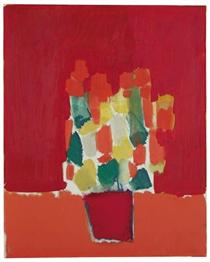
Evolution: From Darkness to Luminous TormentDe Staël's art evolved dramatically in just 15 years:
1940s: Dark, thick impasto, figurative works heavy with wartime anguish (La Vie dure, 1946).
Early 1950s: Shift toward abstraction—blocks of color, textured surfaces, landscapes emerging from pure matter.
Mid-1950s: Brighter palettes, Mediterranean light, return to figuration in abstracted forms—landscapes of Antibes, football stadiums (Parc des Princes), orchestras.
His final phase blended abstraction and representation in vibrating, almost ecstatic color.
Paintings like Nu couché bleu (1955), Grand nu orange (1953), Le Concert (1955), and countless landscapes testify to a painter who chased the impossible:
capturing light's voracity through sheer physicality.
The Inevitable Tragedy
De Staël's end feels tragically inevitable: the exile who never found roots, the orphan who built no lasting home,
the lover who burned for what he could not have, the artist who demanded so much that nothing—family, love, success—could satisfy.
He sacrificed everything for his vision, and when it still eluded him, he chose release.
Yet his legacy endures: over 1,100 oils and drawings, a bridge between abstraction and figuration, a unique voice in postwar art.
Exhibitions at the Pompidou (2003), Musée d'Art Moderne de Paris (2023), and beyond continue to reveal his genius.
Nicolas de Staël did not merely paint—he immolated himself in color and light. His life was a warning and a testament:
genius can be as destructive as it is luminous.
Rest in peace, tormented master.
Your canvases still vibrate with the fire you could not contain.

with help of Google Gemini
< B > My Personal Blog < B > List of all my Blog posts < B >
Article generated & inserted in SQL tables by AIs

FREDDY FRANCE Blog personnel
(c)FPe COPYRIGHT @FPDIEULOIS 2026