 Titan vs Enceladus: Methane Rivers vs Hidden Ice Oceans
 Two Alien Climates, One Big Question
by FPDieulois :: 2026-07-18
with help of xAI Grok
As I sit writing on dieulois.com, scrolling through the 59 articles that came before this 60th one,
I realize how much this blog has become a reflection of my curiosities:
cinema that moves the soul, painting that captures light, history, personal stories,
& those moments when science makes us feel wonderfully small.
From Interstellar to the Artemis program, from Impressionists to AI breakthroughs,
I keep returning to the same wonder
what does it mean to be alive in this vast universe?
Today, I want to take you far beyond Earth: to 2 moons of Saturn that challenge everything we think we know about climate, liquids, and the potential for life.
Titan, with its thick orange atmosphere and rivers of liquid methane, versus Enceladus, a tiny ice-covered world hiding a vast saltwater ocean beneath its frozen crust.
One runs on CH4 (methane) at the surface; the other guards liquid H20 deep inside.
Both are rewriting the rules of habitability.
Personal Pull: Why These Worlds Fascinate Me
I’ve always been drawn to places that feel both familiar and utterly alien.
Titan reminds me of those moody, atmospheric films where the environment is the character
think the hazy, rain-soaked worlds in sci-fi.
Enceladus feels more like a mystery thriller: something alive and active hidden just beneath a quiet, frozen exterior.
After writing about human exploration (Artemis, women in space) and our robotic emissaries (like Rosetta or Oppy on Mars), these 2 moons feel like the next logical step.
They force us to expand our definition of “climate” and “habitable.”
What if life doesn’t need water as we know it? What if a hydrological cycle can run on hydrocarbons in -179°C cold?

Titan: A World of Methane Rivers and Seasonal Haze
Titan is Saturn’s largest moon — bigger than Mercury — and the only moon in our Solar System with a truly thick atmosphere.
That atmosphere, mostly nitrogen with about 1.4% methane, creates a greenhouse effect
and supports a full methane hydrological cycle analogous to Earth’s water cycle.
Clouds form, methane rains (sometimes in dramatic storms), rivers carve channels, and vast seas like Kraken Mare fill with liquid methane and ethane.
Dunes of organic “sand” (tholins — complex hydrocarbons produced by UV and cosmic ray chemistry in the upper atmosphere) stretch for hundreds of kilometers.
Seasons last about 7.5 Earth years each because of Saturn’s 29.5-year orbit.
Recent studies suggest Titan may even have a thick crust rich in methane clathrates (up to six miles thick),
insulating the interior and helping maintain a subsurface water ocean.
The climate is dynamic: lakes and seas are more abundant in the northern hemisphere
right now due to orbital eccentricity creating longer northern summers.
The surface pressure is about 1.5 times Earth’s, but the temperature hovers around -179°C.
Raindrops fall slowly in the dense air. It is a world where natural gas is the “water” of life — or at least of geology and chemistry.
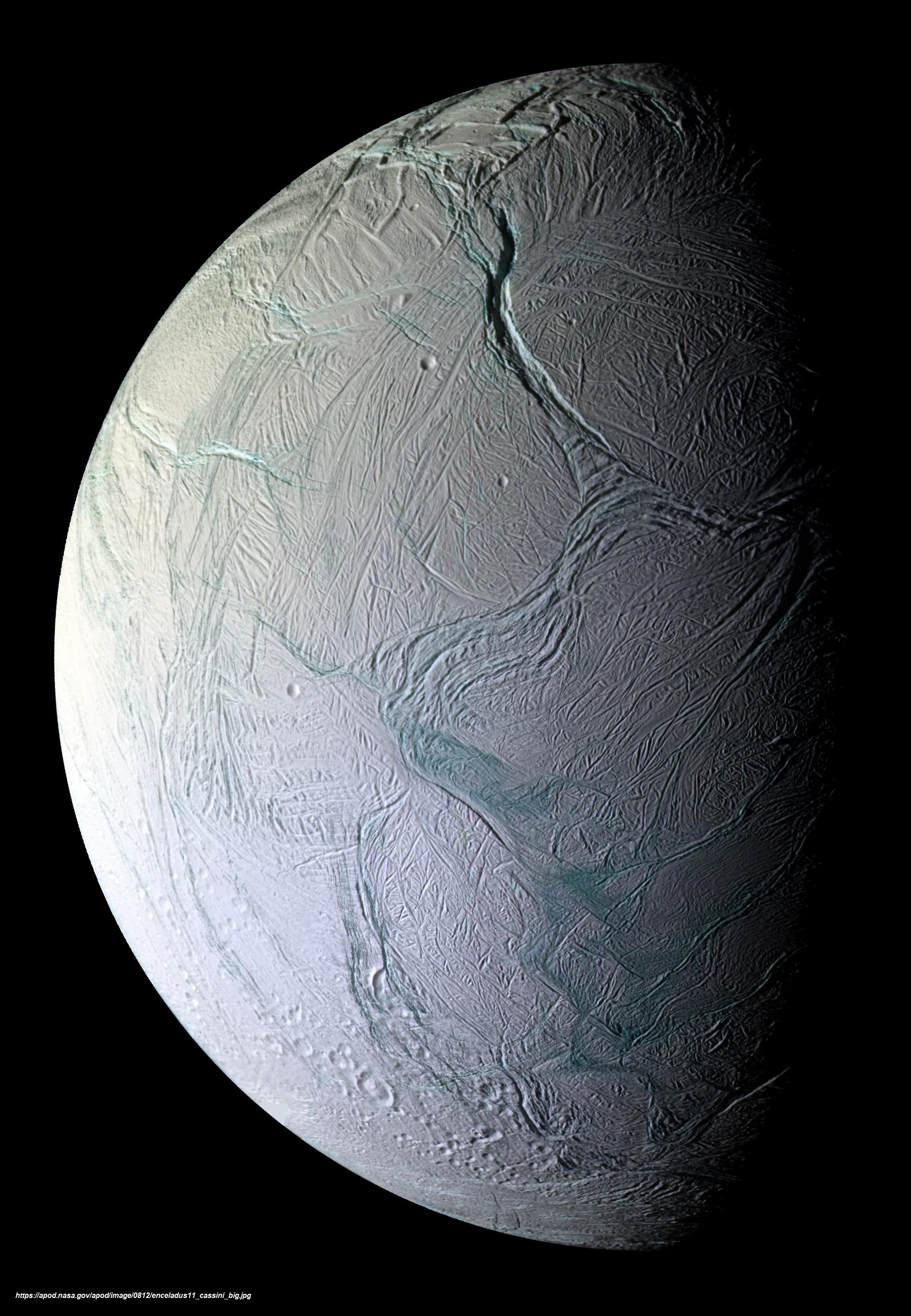
Enceladus: Ice Shell, Global Ocean, and Cryovolcanic Plumes
Enceladus is tiny — only about 500 km across, roughly the width of France
— yet it is one of the most geologically active bodies in the Solar System.
Its surface is almost pure white ice, reflecting sunlight and keeping it frigid (-198°C or so on the surface).
But beneath lies a global saltwater ocean, kept liquid by tidal heating from Saturn’s gravitational pull.
The star of the show: the “tiger stripes” near the south pole
— fractures where over 100 geysers shoot plumes of water vapor, ice grains, salts, and complex organics hundreds of kms into space.
Some material falls back as snow; much feeds Saturn’s E-ring.
Cassini flew through these plumes and tasted the ocean directly:
silica nanoparticles, hydrogen, phosphorus, and organic molecules hint at hydrothermal vents on the seafloor
— the same kind of environment where life may have begun on early Earth.
The ice shell is thin in places (as little as 5 km at the south pole), allowing material from the ocean to reach space.
This makes Enceladus one of the most accessible ocean worlds.
Climate Comparison: CH4 vs H2O/IceTitan’s climate is active and Earth-like in structure but alien in composition.
Methane evaporates from seas, forms clouds, rains out (especially near poles or during equinox storms), and flows in rivers.
There is weathering, erosion, and a rich organic chemistry raining from the sky as tholins.
The cycle operates over decades-to-centuries timescales, with strong seasonal migration of liquids toward the poles.
Subsurface methane reservoirs and a possible warm, convecting ice shell add complexity.
Enceladus’ “climate” is driven by interior heat and tidal forces rather than atmospheric processes.
There is almost no atmosphere. The surface is geologically young and constantly renewed by plume fallout.
The ocean below is thought to be stable over long periods, with hydrothermal circulation providing chemical energy.
Heat flow is concentrated at the south pole, driving the plumes.
It is a cryovolcanic world where “weather” happens in space above the surface.
Key contrast:
Titan: Surface liquids (CH4/ethane), thick atmosphere, slow geological pace, prebiotic chemistry everywhere.
Enceladus: No surface liquids, thin ice shell, vigorous interior activity, direct sampling of ocean chemistry possible.
Both have subsurface water oceans, but Titan’s surface chemistry is far richer in complex organics,
while Enceladus offers easier access to potential hydrothermal vent environments.
Astrobiological Implications
Titan is a laboratory for prebiotic chemistry — the kind that may have preceded life on Earth.
Its tholins and possible azotosomes (membrane-like structures stable in methane) raise the tantalizing possibility of exotic, non-aqueous life.
Enceladus offers more “Earth-like” conditions in its ocean: liquid water, energy, nutrients, and the right pH.
Neither has been proven to host life, but together they show how diverse habitability can be.
Future Exploration
NASA’s Dragonfly mission — a nuclear-powered rotorcraft drone — will launch around July 2028 and arrive in 2034.
It will fly across Titan, sampling different terrains, analyzing organics, and studying the methane cycle directly.
It is perfectly suited to this world: Titan’s dense atmosphere and low gravity make flying efficient.
Enceladus still awaits a dedicated return mission, though concepts like plume fly-throughs or landers are under discussion.
Future missions could combine both.
Closing Thoughts
Writing this 60th article feels special.
From the darkened theaters where I’ve watched cosmic tales on screen to the quiet nights imagining real worlds beyond our own,
Titan and Enceladus remind me why exploration matters.
They are not just distant rocks — they are complete, functioning planetary systems with climates, chemistry, and stories unfolding over billions of years.
One runs on methane rivers under an orange sky; the other whispers secrets through icy geysers from a hidden ocean.
In comparing CH4 and H2O, we learn that the conditions for complexity — and perhaps life — may be far more varied than we once imagined.
Thank you for reading this milestone piece on dieulois.com. The universe keeps inviting us to look farther, think deeper, and stay curious.
What do you think — does Titan’s strange chemistry or Enceladus’ accessible ocean excite you more?

with help of Google Gemini
< B > My Personal Blog < B > List of all my Blog posts < B >
Article generated & inserted in SQL tables by AIs

FREDDY FRANCE Blog personnel
(c)FPe COPYRIGHT @FPDIEULOIS 2026