 Siwarha, the Bracelet of Betelgeuse: A Tiny Companion Dancing with a Dying Giant
by FPDieulois :: 2026-08-27
with help of xAI Grok
As I sit down to write this 62nd article for dieulois.com, I can’t help but smile at how the universe keeps offering perfect sequels.
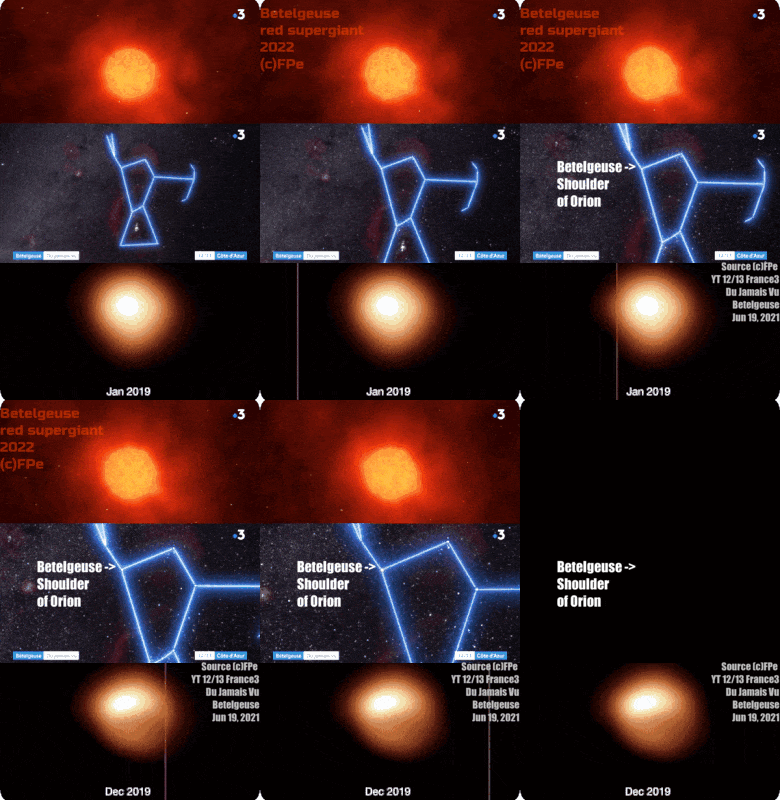
Just after exploring Roy Batty’s attack ships veiling the shoulder of Orion during the Great Dimming of 2019, a new chapter has emerged
— one that adds both scientific depth and poetic beauty to the story of Betelgeuse.
Meet Siwarha — the newly confirmed (or at least strongly evidenced) companion star to Betelgeuse.
Her name, officially recognized by the IAU, means “her bracelet” in Arabic, a fitting companion to Betelgeuse, whose own name translates to “the hand of the giant” (or hand of Orion).
A delicate bracelet orbiting the massive, turbulent hand of a dying supergiant.
It feels almost mythological.The Discovery: From Suspicion to Evidence
For years, astronomers had suspected something was influencing Betelgeuse’s long-term variability
— a roughly 2,100-day (about 5.8-year) cycle that didn’t fit neatly with the star’s main 400-day pulsations.
Radial velocity shifts, subtle changes in brightness, and irregularities in the extended atmosphere all pointed toward a hidden companion.

In July 2025, a team using the ‘Alopeke instrument on the Gemini North telescope in Hawaii announced a probable direct imaging detection of this companion.
Then, in January 2026, NASA’s Hubble Space Telescope and ground-based observatories delivered even stronger evidence:
they detected a clear wake — a swirling trail of dense gas carved through Betelgeuse’s vast outer atmosphere as the smaller star plows through it.
Siwarha is tiny compared to Betelgeuse — roughly 1.5 to 1.6 solar masses, likely a hot, young pre-main-sequence star (F-type).
She orbits extremely close: only about 4 AU (roughly the distance from the Sun to Jupiter), which places her deep inside the extended atmosphere of the red supergiant.
From our viewpoint, she is currently behind Betelgeuse and will emerge again for better observations around 2027.
The Wake: A Boat in a Stellar Ocean
Imagine a small, fast boat cutting through a thick, misty sea.
As Siwarha orbits, she creates a dense trail of gas that expands outward.
Hubble and other telescopes tracked this wake over nearly eight years of observations by watching changes in spectral lines (especially in ultraviolet and optical).
The companion disturbs the chromosphere and outer layers, affecting how much light we see from Betelgeuse
and helping explain part of the erratic behavior we observed during and after the 2019-2020 Great Dimming.
This is the 1st time we’ve seen such a dynamic interaction in a red supergiant system.
It’s not just a passive companion — Siwarha is actively shaping the environment of her giant host.
A Doomed Relationship
Theirs is a tragic celestial romance.
Betelgeuse, a massive red supergiant nearing the end of its life (in astronomical terms: perhaps 10,000 to 100,000 years before supernova), will likely engulf Siwarha long before the big explosion.
The small star is spiraling inward through the dense atmosphere and has no escape.
Siwarha is young — possibly the same age as Betelgeuse (around 10 million years) but at a completely different stage of evolution.
While the giant is burning out dramatically, the bracelet is still approaching the main sequence.
Their story is one of vastly different timescales colliding in space.

Personal Reflection: From Blade Runner to Cosmic Companionship
In 2019, I imagined Roy Batty’s fiery attack ships passing in front of Betelgeuse.
Today, with Siwarha confirmed, the shoulder of Orion feels even more alive — not just a lone dying giant, but a complex system with its own hidden companion and dynamics.
This resonates deeply with the themes I love on this blog: impermanence, beauty in transience, and the stories we tell about creation and endings.
Roy Batty and the Nexus-6 were magnificent but short-lived creations.
Betelgeuse and Siwarha form their own dramatic duo — one burning bright and vast, the other small, energetic,
and destined to merge with its larger partner.It makes me think about companionship in all forms: human, artificial, or stellar.
Even stars don’t always travel alone.Why This Matters
Beyond the poetry, this discovery helps astronomers understand mass loss, variability, and evolution in red supergiants.
It may explain similar behaviors in other stars and gives us a real-time look at how binaries interact in extreme environments.
When Betelgeuse eventually explodes, the presence (or past presence) of Siwarha could influence the supernova’s characteristics.
For now, Betelgeuse continues her unpredictable dance in Orion’s shoulder.
As of mid-2026, she sits around magnitude +0.4 to +0.6 — visible and striking on clear nights, but never boring.
Closing Thoughts on dieulois.com
Writing these astronomy pieces — from Titan and Enceladus to Roy Batty’s ships and now Siwarha’s bracelet — has become one of the great joys of this blog.
Science gives us the facts; imagination and memory give them soul.Next clear evening, look up at Orion.
That reddish star on the shoulder isn’t alone. Somewhere in its glowing atmosphere, a small, brave companion is carving her path
— a bracelet on the hand of a giant, for as long as their doomed dance lasts.
Thank you for reading this 62nd article. The universe keeps revealing new layers of wonder,
and I’m grateful to share them here.Keep looking up.— Dieulois July 2026
with help of Google Gemini
< B > My Personal Blog < B > List of all my Blog posts < B >
Article generated & inserted in SQL tables by AIs

FREDDY FRANCE Blog personnel
(c)FPe COPYRIGHT @FPDIEULOIS 2026